A real conversation about low-cost business ideas that actually make sense for regular people
E
Edriis Franklin
September 27, 2026
A hundred bucks. That's a tank of gas and some groceries, or it's the first real investment you ever make in yourself. The difference between those two outcomes isn't your bank account. It's your decision. And before you roll your eyes and think this is about to be some motivational poster speech, stay with me, because I'm going to be straight with you about what $100 can and cannot do.
It cannot buy you a franchise. It won't cover a commercial kitchen rental or a warehouse. It probably won't even cover a logo designer if you go to the wrong place. But $100 in 2026 can absolutely get a lean, focused online business off the ground. Not to retirement. Not to passive income on a beach. Off the ground. That's the honest version of this conversation.
The Worst Question You Can Ask Yourself
Most people approach this whole thing backwards. They Google 'businesses to start with $100' and try to reverse-engineer a business idea from a list. Then they pick something that sounds profitable, invest their money, get confused or bored in week three, and quit. Sound familiar? It should. It's the most common small business failure pattern there is, and it has nothing to do with the market or the money.
The real question isn't what business can I start. It's what do I actually know, care about, or do naturally that other people would pay to have done for them? That's a different question. It takes longer to answer. But it produces a different result. Your first business should come from something that already lives inside your day, not something you're forcing yourself to fake enthusiasm about for the next two years.
Businesses built around genuine interest have a massive survival advantage. Not because passion pays bills automatically, but because interest keeps you going when growth is slow and results are invisible. And at the start, results are almost always slow and invisible.
What $100 Actually Buys You in 2026
Let's get practical. The digital economy has genuinely lowered the floor on what it costs to look and operate like a real business. Here's a rough breakdown of how far your hundred can stretch if you're smart about it:
A domain name and one year of basic web hosting: roughly $20 to $40
A Canva Pro subscription for one month to create professional graphics: $13
A simple email marketing tool like Systeme.io or ConvertKit free tier: $0 to start
Basic LLC registration in some states: $50 (optional at first, but worth knowing)
A few targeted social media ads to test your offer: $20 to $30
A course or resource to fill a specific skill gap: whatever's left
You're not building a corporation. You're buying enough infrastructure to look credible, test a real offer with real people, and find out if anyone actually wants what you're selling. That's the only goal of the first hundred dollars.
Real Low-Cost Business Ideas Worth Your Time
These aren't random items scraped from a list. These are categories that consistently work for people starting out with minimal cash, minimal experience, and a willingness to actually do the work.
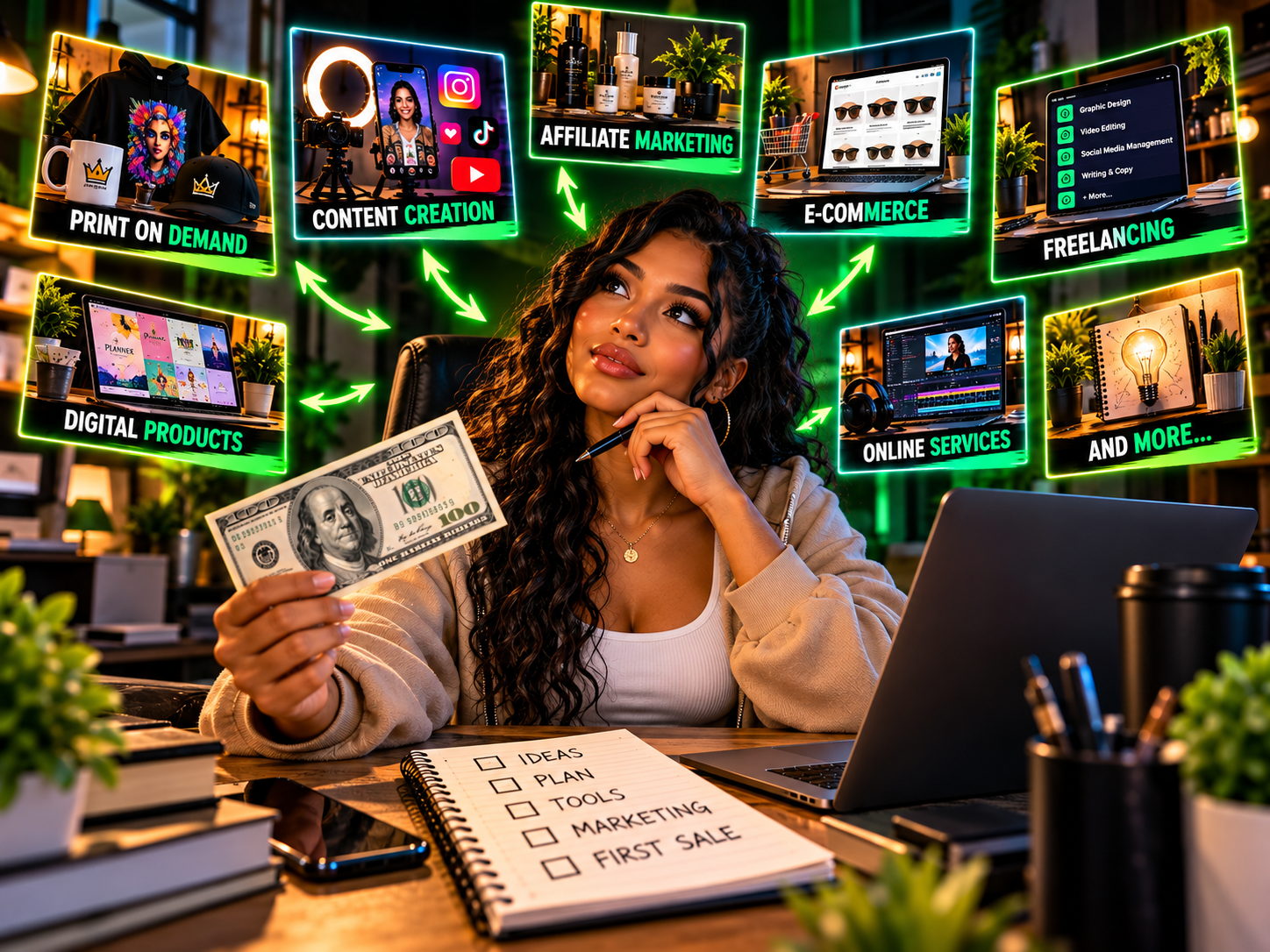
Freelance writing or copywriting: If you can write clearly, businesses will pay you for it. Seriously. Companies need blog posts, product descriptions, emails, and social content constantly. You can be their person.
Virtual assistant services: Small business owners are drowning in administrative tasks they hate. Scheduling, inbox management, data entry, social media posting. You can handle that from your couch.
Reselling (flipping): Thrift stores, Facebook Marketplace, garage sales. Buy low, clean it up, sell it at a real price on eBay or Poshmark. It's unsexy and it genuinely works.
Digital products: Templates, guides, Notion boards, Canva packs. Create once, sell repeatedly. The upfront work is real but the math is appealing.
Social media management for local businesses: That restaurant on your block probably has a terrible Instagram. You can fix that, and they'll pay you monthly to keep fixing it.
Online tutoring or coaching: You know something other people need to learn. A subject, a skill, a process. Package it and charge for your time.
The best low cost business ideas aren't clever. They're just useful. Someone has a problem, you solve it, they pay you. That's the whole model.
E. Franklin
The No-Money Version Is Also Real
If $100 is genuinely not available right now, the conversation about how to start a business with no money is still worth having. Because the honest answer is: you can start certain types of businesses with zero dollars if you're willing to trade money for time. Freelancing requires no upfront investment if you already have a skill and a laptop. Reselling can start with items you already own and no longer need. Offering services to people in your existing network costs nothing except the courage to ask.
The no-money path is slower and messier. You'll be doing more manual outreach, more free work to build a portfolio, more patience-testing groundwork. But it's a real path. Plenty of people who now run profitable small businesses started by doing their first three clients for free or nearly free just to get proof that they could deliver results. That proof is worth more than any logo or website.
What Usually Goes Wrong (So You Can Skip It)
People spend their $100 on things that feel like business but aren't. A logo before they have a single client. A website with ten pages before they've validated their offer. Expensive software subscriptions before they know what problem they're actually solving. This is called playing business instead of doing business, and it's an easy trap to fall into because it feels productive without the discomfort of actually selling something.
Your first sale matters more than your first website. Get someone to pay you for something before you spend a dollar on branding. Prove the idea is real, then invest in making it look good.
How to Actually Choose Your First Idea
Here's a simple filter. Take whatever idea is floating around in your head and run it through three questions. One: can you deliver this without needing a lot of equipment, inventory, or specialized licenses right away? Two: can you find your first five potential customers using only your existing network or free social media? Three: is this something you'd still be willing to talk about and work on six months from now when it's slower than you expected?
If the answer to all three is yes, you have a viable starting point. Not a guaranteed winner. A starting point. The only way to know if it's actually going to work is to go do it and find out. No amount of research or planning replaces that step.
Your $100 Is a Decision, Not a Limitation
Most people reading this aren't being held back by a hundred dollars. They're being held back by uncertainty. By not knowing which idea to pick. By worrying they'll waste the money or look stupid or fail publicly. Those fears are normal and they don't go away the more money you have. People with $10,000 budgets have the same paralysis.
The advantage of starting small is that the stakes are low enough to actually move. You can afford to be wrong. You can test, pivot, and try again without any real damage. The people who figure out how to make money online aren't smarter than you. They just stopped waiting for certainty that was never going to show up and did something with what they had. A hundred dollars is enough to do something. The question is whether you're ready to stop treating it like a limitation and start treating it like a decision.